.jpg)
From quality assurance and compliance to traceability, agility and fulfilment, specialist warehouses are playing an increasingly strategic role in modern supply chains. Matt Bibb, Chief Operating Officer at Commodity Centre, explains how food-grade warehousing is evolving to protect not only products, but value, resilience and customer confidence.
Warehouses have always played a vital role in protecting products. Increasingly, however, they are also protecting something far more valuable: quality, compliance, customer confidence and the resilience of entire supply chains.
Nowhere is that evolution more evident than in specialist food-grade warehousing, where every movement, environmental condition and operational decision can directly impact the value of the goods in storage. As customer expectations grow and supply chains become more complex, warehouse operators are moving beyond traditional storage models to provide integrated services that support customers throughout the entire supply chain.
For Commodity Centre, which has 35 years’ experience in soft commodity warehousing, this shift has transformed the role of the warehouse from a place to store goods into a strategic operational partner.

From storage to strategic partner
Traditionally, soft commodity warehousing focused on bulk storage, preserving quality, inventory management, loss prevention and the efficient handling of goods.
As with many logistics operations, cost efficiency, capacity utilisation and minimising spoilage were key drivers.
Today, however, customers expect considerably more. Specialist warehouses increasingly operate as distribution hubs connecting producers, traders and end users, requiring greater agility and a broader range of capabilities.
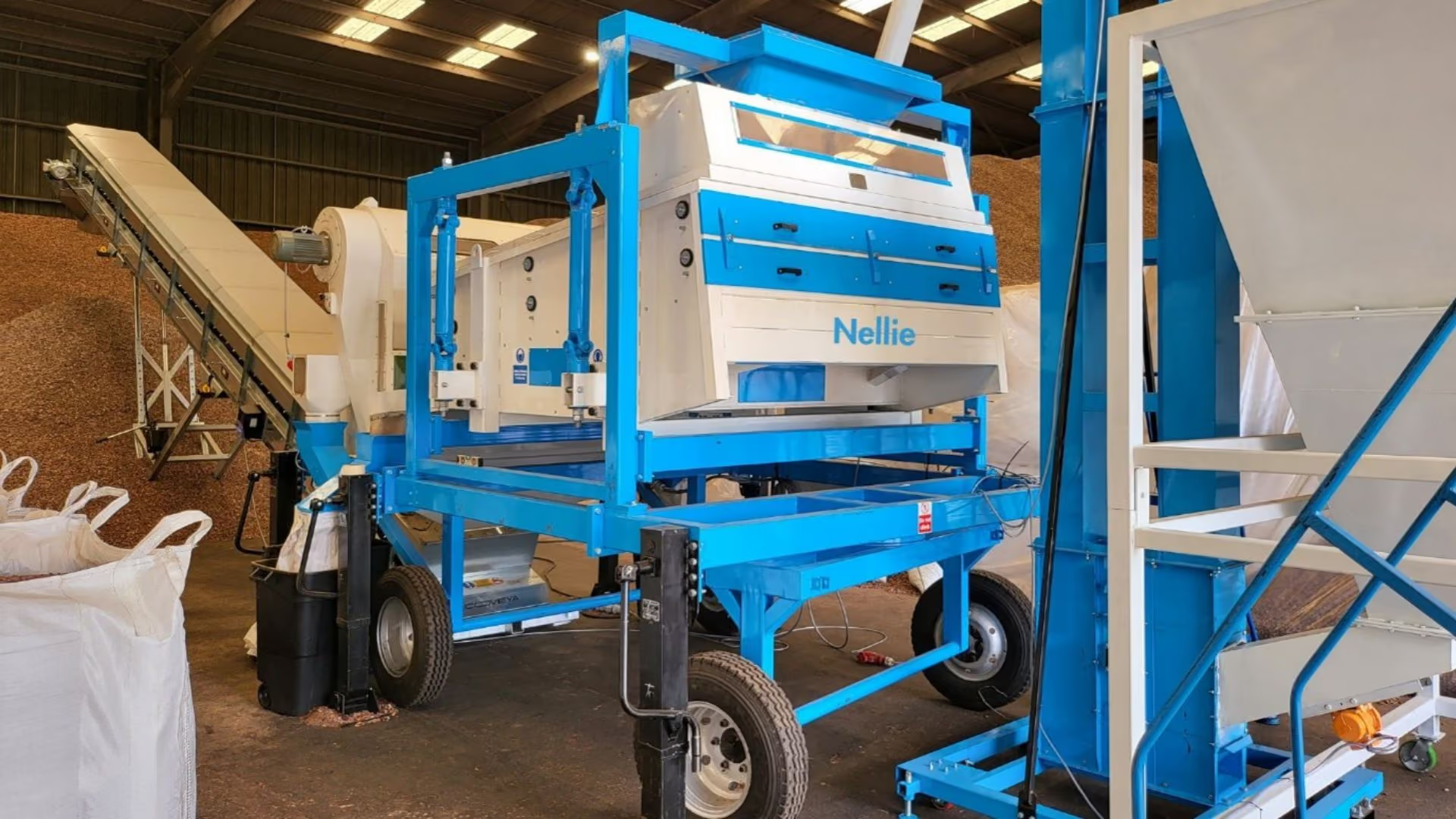
This includes services such as sampling, testing, cleaning, blending, fumigation and pest control, alongside sophisticated inventory management and traceability.
“Real-time inventory is now becoming a minimum standard,” explains Matt. “Our Warehouse Management System needs to be able to digitally track every origin, batch and movement — all fundamental and critical for transparency and compliance.”
The result is a fundamental change in the role of the warehouse.
“We are now end-to-end logistics and technical partners, rather than simply commodity shippers.”
Protecting value every day
The complexity of food-grade warehousing lies in understanding that products are not simply stock — they are valuable commodities whose quality must be actively protected.
“We don’t just store inventory, we protect commodity value and quality,” says Matt.
Natural ingredients can be highly sensitive to environmental conditions. Products such as green coffee beans and sugar require carefully controlled storage environments, with humidity and ventilation continuously monitored to prevent deterioration.
Contamination control is equally critical. Food commodities cannot come into contact with chemicals, rubber or strong-smelling goods, requiring dedicated food-grade areas, strict zoning and robust cleaning protocols.
In one Commodity Centre facility, eight of the 14 major allergens are stored, requiring advanced controls to maintain separation and provide auditable records.
“Our WMS has AI protocols to manage and maintain separation and provide auditable records to show control of these allergens.”
Regular sampling, testing and inspection are also essential. Commodities such as coffee are graded according to factors including bean size and defects, meaning inventory movements must be accurately tracked to maintain product integrity.
Built for agility
While compliance and control are essential, modern warehouse operators must also be able to respond quickly when customer requirements change. Many soft commodity supply chains experience seasonal fluctuations, requiring additional accredited capacity at short notice. For Commodity Centre, agility means having the operational capability and partnerships in place to respond without compromising standards.
Recently, one customer approached the business with a 30,000 pallets storage requirement and only a few weeks’ notice. The team secured additional warehouse space, negotiated agreements, prepared the facility, recruited additional resource and began receiving commodity just six weeks later.
Another customer required a specialist solution involving sourcing the right facility, establishing commercial agreements and taking delivery - all within seven days.
“These projects highlight what agility means at Commodity Centre: coordinated teamwork across commercial and operational functions, fast decision-making and a commitment to meeting customer needs without compromising on safety, compliance or cost.”
Visibility creates confidence
Technology has become central to improving control, transparency and decision-making within specialist warehousing. Commodity Centre’s Warehouse Management System provides customers with accurate stock visibility by lot, origin and grade, supporting decisions around sales, blending and logistics. Customers also have access to digital portals showing inventory positions, movements and documentation remotely, reducing reliance on manual updates and improving transparency. Barcode scanning and lot tracking provide full traceability from intake through to dispatch, while sensors monitor environmental conditions such as temperature and humidity in real time.
“Through our WMS we have implemented a digital workflow - from intake and sampling through to dispatch - to reduce human errors, improve consistency and create auditable records for every pallet stored with us.”
For customers, this provides confidence that the quality and value of their commodities are being protected.
The next step: specialist fulfilment
The expansion into food and drink e-commerce and fulfilment represents a natural extension of specialist warehousing capability. Food and drink products require a higher level of care, control and traceability than many other fulfilment environments, making specialist expertise increasingly valuable.
The service builds on existing capabilities in inventory management, quality control and traceability, extending these into areas such as pick-and-pack, order processing and distribution. By keeping finished goods within a controlled warehouse environment, customers benefit from a more integrated, dynamic and flexible approach while maintaining the standards expected within food supply chains.
This reflects a wider industry shift, where customers are increasingly looking for partners who can provide complete, responsive solutions rather than standalone services.
Looking ahead
Over the next decade, leading warehouse operators will be defined by their ability to combine resilience, agility, embedding AI, digital capability and integrated services. Supply chains will continue to face disruption from climate change, geopolitical pressures and capacity constraints, meaning operators must provide flexibility while maintaining rigorous standards of compliance and quality. Digital visibility, predictive analytics and seamless system integration will become increasingly important, while sustainability will remain a key priority through investment in areas such as energy efficiency and waste reduction. Ultimately, warehouses will continue to evolve into multifunctional supply chain hubs, combining storage, handling, processing and fulfilment capabilities.
The future warehouse will not simply hold products - it will help customers manage, protect and optimise their entire supply chain.
Our warehouses are not just storing product. They’re preserving a tradable asset whose value is highly sensitive to how it is handled by our teams every single day.